Astroport Space Technologies, headquartered in San Antonio, Texas USA, and FourPoint, headquartered in Wrocław, Poland, announce they are joint signatories of a Memorandum of Understanding (MOU) for collaboration on the construction of a lunar launch and landing pad (LLP).
To enable safe landings at lunar camps, the collaboration effort will initially focus on developing the construction technologies and civil engineering processes needed for establishing an LLP for NASA’s Artemis return to the Moon programme. More specifically, Astroport is developing patent pending technology for melting the lunar soil (regolith) to form durable Moon bricks using its LunatronTM brickmaking machine. The bricks can then be used as pavement for planar surfaces such as landing pads, roads, or foundations for structures. Astroport has received separate research funding for developing its furnace melting technology, as well as for the LLP site preparation process.
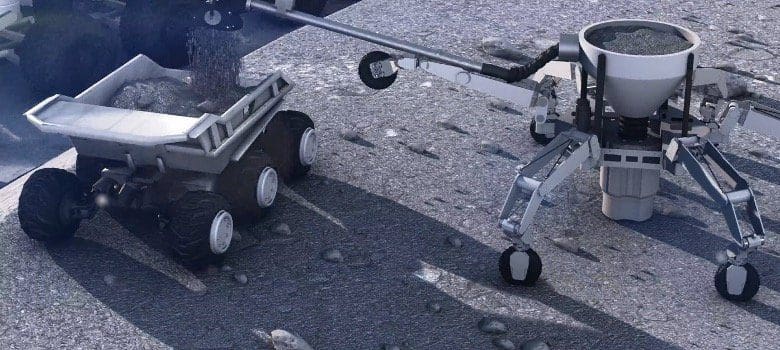
Regolith feedstock for brickmaking is acquired from the excavation and leveling phase for the landing site preparation. For this, FourPoint will use its Autonomous Transport Platform (ATP) for hauling and conveyance of sorted and filtered material to feed the LunatronTM brickmaker. FourPoint’s ATP offers a complete solution for autonomous machine operation, adapted to work in specific areas which improves the speed and efficiency of work in opencast mines, as well as other extreme environments such as on the lunar surface. FourPoint will join Astroport’s international partner network of companies and academic research organisations developing the LLP construction concept of operations and associated technologies.
Astroport and FourPoint are graduates of the European Space Resources Innovation Centre (ESRIC) Start-up Support Programme (SSP). They were competitively selected to join the first ESRIC SSP cohort of only five companies chosen from over 33 applicantions received from 17 countries around the world. FourPoint was selected to be the 1st incubated Start-up of the SSP and go forward to Phase 2 of the programme. The two companies intend to establish subsidiary operations in Luxembourg.
Sam Ximenes, Space Architect and CEO of Astroport said, “As the only US company selected to participate in this European programme, we are extremely pleased with our involvement. Through the SSP we were introduced to FourPoint and their synergistic capability. We look forward to growing our joint skillsets and technologies for building out lunar infrastructure together”.
Marek Wilgucki, Chief Executive Officer of FourPoint said, “We are happy to join Astroport and its international partner network of organisations involved in the LLP project. The participation in the ESRIC SSP gave us the unique opportunity to connect with amazing companies and individuals building up a future lunar economy. Our cooperation with Astroport will enable us to increase our knowhow, develop new technologies and foster economic collaborations between Luxembourg, the USA and Poland.”
About Astroport: Astroport Space Technologies Inc., is a space construction and materials manufacturing company turning planetary resources into durable feedstock for autonomous construction of lunar surface infrastructure. Headquartered in San Antonio, Texas USA, Astroport was founded with a vision to design, deploy, and operate interplanetary landing ports to facilitate safe, reliable, and efficient spaceflights to the Moon, Mars and beyond. Astroport is a deep tech startup founded in 2020, operating as a technology venture arm of Exploration Architecture Corporation (XArc), a space architecture consulting design and engineering firm established in 2007.
About FourPoint: FourPoint Sp. z o. o., is a Polish space technology company, which provides full value chain services including design, manufacturing, integration, launch and on Moon operations for complete Autonomous Payload Transportation systems, as well as data acquisition. FourPoint provides solutions across terrestrial mining value chain especially with its tools utilizing satellite remote sensing techniques for prospecting, monitoring ecological impact and reporting. FourPoint specializes in electrification of mining equipment, development of autonomous machines for resources excavation and an application to monitor: mining sites, detect illegal mining operations, environmental mining impact, deforestation impact.